
Lake Powell RV parks: hookups, rig limits and dump stations
Six Lake Powell RV parks compared: full-hookup counts, rig-length caps, published 2026 nightly rates, and the 2-vehicle rule that catches anyone towing a boat.
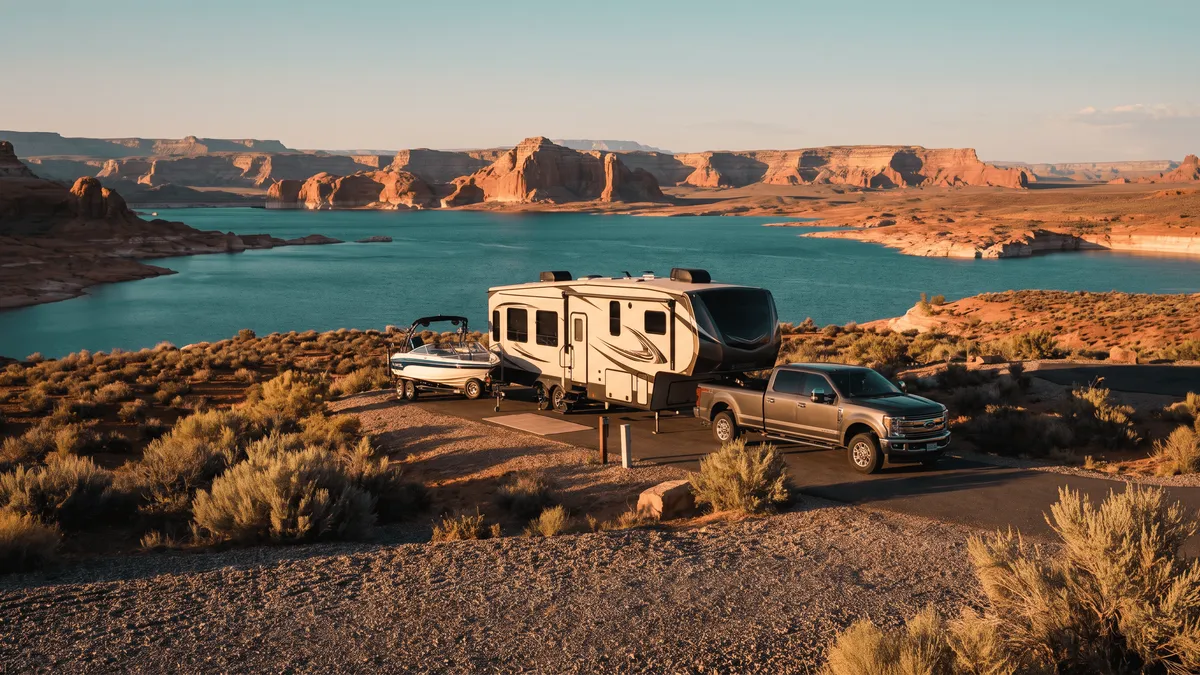
Quick answer
Lake Powell has 4 RV parks with full hookups: Wahweap (139 sites, up to 45 feet), Antelope Point (100 sites, 70-foot lots), Halls Crossing (31 pull-throughs, up to 60 feet) and Bullfrog (22 spaces, up to 50 feet). Antelope Point takes the longest rigs and posts its nightly rates online, while Wahweap quotes you in the booking flow. If you’re towing a boat behind the RV, book Bullfrog or Halls Crossing — Wahweap caps a site at 2 vehicles, and your trailer counts as one.
Six places around Lake Powell take an RV. Four sit inside Glen Canyon National Recreation Area, one is on Navajo Nation land at Antelope Point, and one is a commercial park in town.
| Park | Full-hookup sites | Max rig | Power | Published nightly rate |
|---|---|---|---|---|
| Wahweap RV & Campground | 139 | 45 ft (a few over 70) | 30 and 50 amp | Not published |
| Antelope Point Marina RV Park | 100 | 70-ft lots | 30 and 50 amp | $70 back-in, $80 pull-through |
| Halls Crossing RV & Campground | 31 pull-through | 60 ft | Not listed | Not published |
| Bullfrog RV & Campground | 22 (18 pull-through) | 50 ft | 30 amp | $60 plus tax |
| Page Lake Powell Campground | Count not published | 45 ft | 30 and 50 amp | Not published |
| Lone Rock Beach | 0 (sand, no hookups) | No stated limit | None | $14 per vehicle |
Rates are as of mid-2026 and sit on top of the $30 per-vehicle park entrance fee, good for 7 days, or $55 for the annual pass. Launching a boat adds a vessel fee that scales with length: $30 a week for 26 feet and under, $50 for 27 to 40 feet, $100 for 41 to 60 feet.
Which Lake Powell RV park should you book?
Book Antelope Point if your rig is long and you want a published price before you commit. It lists 100 full-hookup sites on 70-foot lots with 30- and 50-amp service, though Recreation.gov counts 104 spaces there. The marina posts $70 a night for a back-in and $80 for a pull-through, $420 and $480 by the week, less 10% for Good Sam members, military and slip owners. A 24-hour cart shuttle runs guests down to the docks, because the RV park sits on a mesa above the marina.
Book Wahweap if you want the most full-hookup sites inside the park and the shortest walk to services. The concessioner lists 139 full-hookup spaces across loops A, B, C, D and F, with laundry, showers, a store, a dump station and potable water. The federal Recreation.gov listing for the same campground still describes 90 full hookups and 112 dry sites, so treat the concessioner’s number as current and confirm the loop when you book. Book Bullfrog or Halls Crossing for the north lake, and Page Lake Powell Campground if you’d rather have an indoor pool and shade than a lake view.
Antelope Point charges a $30 entrance fee for the Navajo Nation property, waived with a National Park Service or senior pass, and closes its restrooms and showers from early November to early March.
How long an RV fits, park by park
Halls Crossing takes the longest rigs inside the park: 31 pull-through spaces with full hookups that accommodate up to 60-foot RVs. Bullfrog caps at 50 feet across 22 spaces, 18 of them pull-through. Wahweap advertises 45 feet in its full-hookup loops, with “very limited options exceeding 70 feet” — call and ask for those by name rather than assuming one is free.
Loops 2, 3 and 4 hold 112 no-hookup sites that take a self-contained RV up to roughly 30 feet, and Loop 1 adds 36 tent-only sites. For a Class C or a van that doesn’t need shore power, those loops are the cheaper way in.
Antelope Point’s Recreation.gov listing puts the maximum length at 70 feet, the longest stated cap of the 5 developed parks. An RVer who stayed there in October 2023 described the sites as “long and wide, perfect for extra long trailers and motorhomes”, with a separate concrete pad for a table or fire pit. The same writer flagged the trade-off: the park “sits on top of a mesa and can get very windy,” and management had posted signs about leaving an awning out. Shade is thin because the trees are young.
Can you bring a boat trailer to a Lake Powell RV site?
Check the vehicle cap before you book, because it changes by campground. The 2026 Superintendent’s Compendium, signed January 1, sets a maximum of 2 vehicles per site at Wahweap Campground and 3 per site at Bullfrog and Halls Crossing — and the rule says outright that the count “includes camper trailers and boats.” An RV, a tow vehicle and a boat on a trailer is 3. At Wahweap that’s over the line.
The same section requires all vehicles and trailers at Wahweap and Bullfrog to be parked on pavement inside the site, and caps an individual site at 8 people.
The concessioner’s booking pages don’t mention any of it, so ask when you book — Wahweap lists 888-896-3829 for reservations, and a second boat trailer may need its own site or an overflow lot. Antelope Point sits outside Glen Canyon’s boundary on Navajo Nation land, so the compendium’s vehicle count doesn’t govern it, and its lots are the easiest place to keep a rig and a trailer together.
Where can you park an RV without hookups?
Lone Rock Beach is the answer for most people, at $14 per vehicle per night. It’s a wide sand flat on the Utah side off Highway 89, first-come, and the only place in Glen Canyon where you can drive to the waterline and sleep beside the rig. The park’s Lone Rock page lists restrooms, outdoor showers, running water and an RV dump station during the season, then adds the sand warning: “After the pavement ends, the roads get increasingly sandy the closer you get to the water.” There’s no guaranteed towing if you bury it.
Farther north, Stanton Creek runs $12 a night with no potable water, and the park recommends 4WD “for the sandstone hills and the sandy stretches of road.” Its Recreation.gov listing adds that when the pit toilets are out, campers have to bring a portable one. Beehives/Ferry Swale near Page is open, but the compendium caps you at 3 consecutive days there. Hite’s services are closed until further notice.
Dispersed camping has hard geography rules: stay a quarter mile off Highway 89 inside the recreation area, 100 feet off any paved or campground access road, 300 feet from a structure, launch ramp or airstrip, and a half mile from a trailhead.
Where are the RV dump stations at Lake Powell?
Two are named as RV dumps in the park’s spring 2026 season release: Lone Rock, where “potable water, RV dump services and additional vault toilets are open,” and Lees Ferry, where “the fish cleaning station, RV dump and the campground upper loop are open.” Bullfrog is listed for land-based portable toilet dumps rather than an RV dump. Wahweap’s campground carries a dump station and potable water per its Recreation.gov listing, and Antelope Point’s listing shows 2 RV dump stations.
Carry water for Lone Rock anyway. The park’s Lone Rock page says there’s “no potable water” there; the April 2026 season release lists potable water as open. Until the park reconciles the two, fill the tank in Page and treat the tap as a bonus.
A self-contained RV toilet meets the park’s waste-containment requirement. The compendium requires anyone camping within a quarter mile of the shore to carry a means of containing solid waste and names “a self-contained toilet in a recreation vehicle” as one; the requirement applies when a site sits more than 200 yards from a constructed toilet, or that toilet is closed. Dump the tank at a designated station; emptying containers into restroom toilets or trash cans is prohibited.
Can you drive an RV between Bullfrog and Halls Crossing?
In 2026 you drive the long way around. UDOT’s ferry status page says the crossing “is not operating” and “is not anticipated to operate in 2026.” The two ferry docks face each other across the channel; by road via State Route 95 the distance between them is about 149 miles. The lake conditions behind that closure are tracked at lakepowellwaterlevel.com.
Pick a side of the north lake and stay on it. Bullfrog comes off Utah 276 from Hanksville, Halls Crossing off Utah 276 from Utah 95 near Natural Bridges. Both are paved, both run long stretches with no fuel, so top off before you commit. When the ferry does run it takes RVs and trailers at $25 per vehicle plus $1.50 per foot for the entire length of anything over 20 feet, first-come, about 25 minutes across.
The Bullfrog Marina guide and Halls Crossing Marina guide cover fuel and ramps on each side, and the 9 best Lake Powell camping spots covers the boat-in coves if you’d rather sleep on sand.
How many days can you camp at Lake Powell in an RV?
The compendium and the fees page give different answers. Under the compendium, land-based camping at any Glen Canyon campground that charges a fee or requires a permit is capped at 30 days total in the park per calendar year, against 60 for anyone camping off a boat, with the same 14-day cap in one location either way. The fees page flattens all of that to “14 consecutive days and 30 days total per season,” which under-reports what a boat camper is allowed. Go by the compendium — it’s the regulation the rangers enforce.
Generators and audio devices are prohibited from 10 p.m. to 6 a.m. in developed campgrounds, and during permitted hours a generator has to be muffled. At Page Lake Powell Campground, in town and outside park rules, quiet hours run 11 p.m. to 7 a.m.
What this means for the drive to the water
Wahweap RVers on Campendium keep making the same point about distance. One June 2026 reviewer wrote that sites are “NOT walking distance to the lake….it’s over a mile drive away.” Antelope Point runs its cart shuttle for the same reason. In each case you’re driving to the ramp with a boat behind you, in the dark at least once.
Cell service thins out fast past the marinas here, so the ramp you picked on a laptop at home isn’t guaranteed to load on your phone at 5 a.m. Check the interactive lake map for every launch ramp and all 4 marinas; the app holds them offline once you download it.
Key takeaways
- Wahweap caps a site at 2 vehicles and the count includes camper trailers and boats; Bullfrog and Halls Crossing allow 3.
- Halls Crossing takes 60-foot rigs, the longest cap inside the park, and Antelope Point’s listing says 70.
- Antelope Point and Bullfrog publish nightly rates ($70/$80 and $60 plus tax); Wahweap and Halls Crossing quote in the booking flow.
- The park names RV dumps at Lone Rock and Lees Ferry; Antelope Point lists 2 of its own.
- The Bullfrog to Halls Crossing ferry isn’t expected to run in 2026, which makes the crossing a 149-mile drive.
Frequently asked questions
Which Lake Powell RV parks have full hookups?
Four at the lake, plus one in town. Wahweap RV & Campground has 139 full-hookup sites with 30- and 50-amp service, water and septic. Antelope Point Marina RV Park has 100 full-hookup sites on 70-foot lots, also 30 and 50 amp. Halls Crossing has 31 full-hookup pull-throughs, and Bullfrog has 22 full-hookup spaces on 30-amp service. Page Lake Powell Campground in town adds full-hookup RV sites alongside cabins and tent pads, though it doesn’t publish a site count.
How long an RV can you bring to Lake Powell?
Halls Crossing takes the longest rigs inside the park at 60 feet across 31 pull-through spaces. Bullfrog caps at 50 feet, and Wahweap advertises 45 feet with a very limited number of spaces over 70. Antelope Point Marina publishes 70-foot lot space rather than a stated maximum, which makes it the easiest fit for a long fifth wheel plus a tow vehicle. Page Lake Powell Campground caps at 45 feet.
How much does an RV site at Lake Powell cost?
Bullfrog publishes $60 a night plus tax for a full-hookup space. Antelope Point publishes $70 a night for a back-in and $80 for a pull-through, or $420 and $480 by the week. Wahweap and Halls Crossing do not publish RV rates online — you get the price in the concessioner’s booking flow at lakepowell.com. RVers posted $64 to $100 a night for Wahweap on Campendium between 2023 and 2026.
Can you park an RV at Lone Rock Beach?
Yes. Lone Rock is the one place in Glen Canyon where you can drive onto the sand and sleep next to your rig, and it is the only spot in the recreation area where non-street-legal vehicles are allowed to operate. There are no hookups. The National Park Service says restrooms, outdoor showers, running water and an RV dump station run during the season, and warns there is “no potable water, no RV pumpout, and no guaranteed towing service if you get stuck in the sand.”
Where can you dump an RV holding tank at Lake Powell?
Lone Rock and Lees Ferry are the two the National Park Service names as RV dumps in its spring 2026 season release. Bullfrog is listed for land-based portable toilet dumps instead, and the Wahweap and Antelope Point RV parks each carry dump facilities of their own. Wherever you empty it, the Superintendent’s Compendium requires waste from containers to go into a designated pump-out or dump station, never into a restroom toilet or a trash can.
Can you take an RV on the Bullfrog to Halls Crossing ferry?
Not in 2026. The Utah Department of Transportation says the Lake Powell ferry “is not operating” and “is not anticipated to operate in 2026.” The service does take RVs and trailers when it runs, boarding first-come with no reservations and charging by vehicle length. While it is down, reaching the far terminal means a long detour on State Route 95 instead of a 25-minute crossing, so plan a north-lake trip around one side of the channel.
How many days can you camp at Lake Powell in an RV?
The 2026 Superintendent’s Compendium caps land-based camping at any fee or permit campground at 14 consecutive days in one location and 30 days total in the park per calendar year. Camping from a boat gets a longer allowance — 14 consecutive days and 60 days total. Beehives/Ferry Swale is stricter than both at 3 consecutive days. Generators and audio devices are prohibited from 10 p.m. to 6 a.m. in developed campgrounds.
Find the ramp before you back down it
The Navigator app keeps every launch ramp and all 4 marinas on your phone offline, so the drive from your RV site to the water is settled before you unhitch.