
The 9 best beaches on Lake Powell (by boat or by car)
The 9 best beaches on Lake Powell, south to north — Lone Rock to Good Hope Bay — with camping rules, fees, and how boaters claim a good stretch of sand.
Quick answer
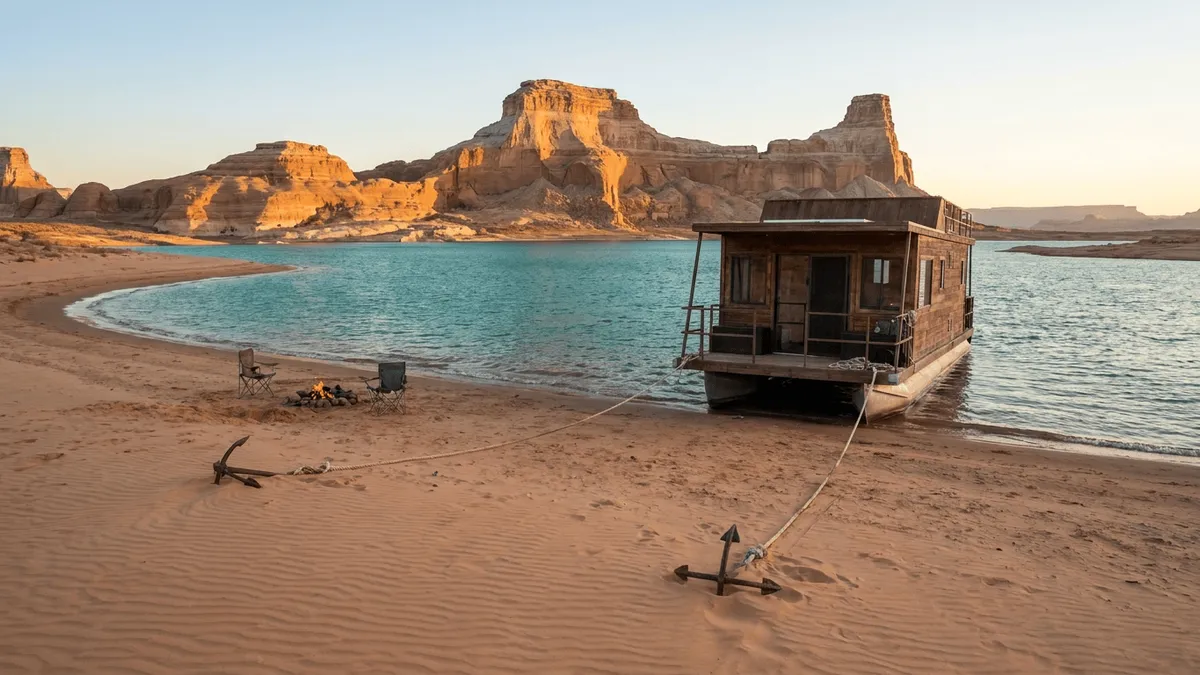
Lone Rock Beach near Wahweap lets you drive onto the sand; the rest of the best you reach by boat. Working south to north: Warm Creek Bay and Padre Bay hold the biggest sand near Wahweap, Gunsight and Labyrinth trade size for seclusion, and Stanton Creek, Halls Creek Bay and Good Hope Bay cover the north lake. Shoreline camping is free — bring a portable toilet, because one is required.
This list runs south to north, from Glen Canyon Dam up-lake, because that’s how you’ll meet these beaches from the water. A note before you pick one: sand on this lake moves. The same cove can be a wide bench one summer and a narrow shelf the next as the lake rises and falls — check the current water level at lakepowellwaterlevel.com before you go, then confirm with your own eyes when you arrive.
| Beach | Where | Get there by | Best for |
|---|---|---|---|
| Lone Rock Beach | Wahweap area, UT side | Car or boat | Drive-up camping, big groups |
| Wahweap Swim Beach | Across from Wahweap Campground | Car (day use) | Kids, motor-free swimming |
| Warm Creek Bay | A few miles from Wahweap | Boat | First-night houseboat camps |
| Padre Bay | About lake mile 19 | Boat | Classic sand coves, multi-day trips |
| Gunsight Canyon | Off Padre Bay | Boat | Semi-seclusion mid-lake |
| Labyrinth Canyon | Padre Bay region | Small boat | One-boat pocket beaches |
| Stanton Creek | Bullfrog area | Car or boat | North-lake convenience |
| Halls Creek Bay | ~93 lake miles above the dam | Boat | Lots of sites, big bays |
| Good Hope Bay | Upper lake | Boat | Room and quiet, self-contained trips |
1. Lone Rock Beach — the drive-up classic
Lone Rock is one of the very few places on the lake where you can drive a vehicle onto the sand and boat right up to the same shoreline. It sits just north of the Utah line off US-89, in sight of the sandstone monolith it’s named for, and it’s the busiest beach on the lake for exactly that reason.
Camping is first-come, first-served, year-round, and costs $14 per vehicle per night on top of the park entrance fee (as of mid-2026, $30 per vehicle for 7 days). Vault toilets are spread across the beach, with seasonal showers, potable water and a dump station near the paved entrance. Two warnings the NPS makes plainly: the sand gets soft near the water and the park doesn’t guarantee a tow, and glass containers are banned on the beach. There’s also a fenced ORV area — the one spot in the park where non-street-legal off-road vehicles can run.
2. Wahweap Swim Beach — the motor-free option
Wahweap Swim Beach is a day-use beach across from Wahweap Campground, and it’s the only downlake swimming spot where motorized boats can’t come past the buoy line. That makes it the calmest place on the southern lake to put kids in the water, with only paddle craft — kayaks and boards — past the sand.
Park in the gravel lot on Lakeshore Drive between the picnic area and Stateline ramp, and walk the sandy path down. One portable toilet on the way is the last restroom before the water, so plan accordingly. No camping here, no glass, no lifeguard — that last one is true of the entire lake. If your group is staging out of Wahweap Marina, this beach is the easy answer for the afternoon before the houseboat checks in.
3. Warm Creek Bay — the first-night beach
Warm Creek Bay is where a huge share of Wahweap houseboat trips spend night one, and it earns it: a short run from the marina, wide sandy shorelines, and enough side coves that you can usually find shelter from a south wind. Fred’s Guide has called its beaches extensive for decades, with the honest caveat that the exact sand depends on the lake that year.
The move is to leave the marina with time to spare, pick your cove while the light is good, and anchor for the night — the park itself recommends beaching boats overnight because high winds move floating boats into rocks. Open beaches here have long views; the coves give you wind protection and fewer neighbors.
4. Padre Bay — the classic sand coves
Padre Bay, around lake mile 19, is the largest open water on Lake Powell and the densest collection of sandy coves on the southern half. Cookie Jar Butte and the bay’s many inlets hide campsites large and small, and most veteran boaters would put their favorite beach somewhere in this bay.
The north side runs up against high Glen Canyon cliffs, so the bigger benches tend to sit on the other aspects. On summer weekends the well-known coves fill by afternoon — the standing tactic on boater forums is to send the fast boat ahead of the houseboat to scout and hold a spot. If you’re planning the run up, the distance guide puts the legs and fuel in one place.
5. Gunsight Canyon — small on purpose
Gunsight Canyon, tucked between Padre Bay and the main channel, has fewer beaches than its big neighbor — and that’s the appeal. Trip reports pick it precisely because fewer houseboats fit, so the camps that exist feel like yours. There’s still real sand: boaters on WaynesWords describe plenty of beaches in Gunsight and around the corner in Padre.
Fewer sites means the good ones go early. Treat Gunsight as a first-choice-with-a-backup, not a guarantee, and have a Padre Bay cove in your pocket for the weekends it’s taken.
6. Labyrinth Canyon — pocket beaches in a slot
Labyrinth Canyon is the nearest navigable slot to the Wahweap side, a narrow, twisting corridor best entered with a runabout or PWC, throttled way down. At the back and in small side pockets, sand collects into compact one-or-two-boat beaches with canyon walls straight out of the postcard.
These pockets come and go with the lake, so treat any specific report as a snapshot. Idle in, look, and commit only when you can see the slope. It’s a different kind of beach day — less volleyball, more quiet — and it pairs well with a morning exploring the walls. For more canyons worth the detour, see our guide to Lake Powell’s side canyons.
7. Stanton Creek — the north lake’s front porch
Stanton Creek, on Bullfrog Bay, is the north lake’s version of convenience: shoreline camping close enough to marina services that forgetting the ice isn’t a crisis. A primitive campground at Stanton Canyon brings drive-in campers to the same shoreline boaters beach on, so it’s a mixed crowd — trucks and tents on one stretch, houseboats on the next.
Note for 2026: Bullfrog’s floating marina services have temporarily moved to deeper water near Halls Crossing, so check the Bullfrog Marina guide for what’s operating where before you count on fuel or supplies at the ramp side.
8. Halls Creek Bay — quantity has a quality
Halls Creek Bay, about 93 lake miles above the dam, is the north lake’s big beach warehouse. Fred’s Guide counts many good campsites here while warning that seclusion is hard because everyone knows it — and that some of the side canyons entering the Waterpocket Fold nearby are steep-walled with no campsites at all.
Scout it slowly on arrival. The bay’s entrance reads misleading on charts, and a promising-looking side canyon can turn out to be all rock. When you find sand, there’s usually a lot of it, with room for a multi-boat camp.
9. Good Hope Bay — the far, quiet one
Good Hope Bay sits in the upper lake, past the point where most weekend traffic turns around. When the lake cooperates, its margins open into broad sand and mud beaches with space for several houseboats to spread out far beyond earshot of each other. This is the beach for the fully self-contained trip.
Plan fuel like it matters, because it does: Dangling Rope Marina is permanently closed, so there is no fuel between the north-lake marinas and Wahweap — a round trip from either end has to carry its own margin. Run the numbers with the fuel planning guide before committing to the upper lake.
The rules for camping on a Lake Powell beach
Shoreline camping outside developed marinas is free and needs no permit, but the NPS camping rules that come with it are specific and enforced. The big one: every beach camp must have a portable toilet, unless your vessel has one aboard or there’s a toilet within 200 yards. Burying waste is prohibited, and a plain plastic bag doesn’t qualify — use a real wag-bag system. The park connects the dots in its own water advisory: waste left at busy beaches like Lone Rock ends up in the water people swim in.
The rest, quickly:
- Campfires: below the high-water mark, wood only, 4 feet wide and high at most. No fireworks, ever. Fire restrictions can suspend all of it in a dry stretch.
- Quiet hours 10 p.m. to 6 a.m., unless otherwise posted.
- Stay limits: 14 consecutive days, 30 days per year in the park.
- Camping 100 feet or more back from the shoreline, groups over 12 must split and camp at least half a mile apart.
- Houseboats sharing a beach park at least 100 feet apart — that’s a carbon monoxide rule, since generator exhaust pools around swim platforms in calm coves.
- Cliff jumping and diving are prohibited in Glen Canyon from any cliff, ledge or structure 15 feet or more above the surface. Boats are excluded from that rule.
One more habit worth keeping: glance at the water before anyone swims. A pale-green film or surface scum means pick another cove and report it — the park tracks harmful algal blooms, and no beach is worth a sick kid. Wind is the other daily factor; afternoon blows are routine here, and the weather safety guide covers how to read a building storm before it reads you.
Key takeaways
- Lone Rock is the only drive-up beach; it costs $14 a night per vehicle, and everything else on this list is free to camp.
- By boat, the southern lake’s best sand clusters in Warm Creek Bay and Padre Bay; the north lake’s in Halls Creek and Good Hope.
- A portable toilet is legally required at every beach camp — pack it or camp within 200 yards of one.
- Beach the boat overnight, park houseboats 100 feet apart, and skip the cliff jumping — it’s prohibited from 15 feet up.
- Sand moves with the lake. Scout by eye when you arrive, and send the fast boat ahead on summer weekends.
Frequently asked questions
Can you camp on any beach at Lake Powell?
Almost. The National Park Service allows camping anywhere along the Lake Powell shoreline except in developed marinas, with no camping fee or permit — you pay only the park entrance fee. The one exception is Lone Rock Beach, which charges $14 per vehicle per night because you can drive onto it. Stays are capped at 14 consecutive days and 30 total days per calendar year across the park.
Do I need a portable toilet to camp on a Lake Powell beach?
Yes. Every shoreline campsite must have a portable toilet unless your boat has one aboard or there’s a toilet within 200 yards of camp. Burying human waste on the beach is prohibited, and plain plastic bags don’t count — only engineered wag-bag systems designed to treat waste are accepted. Rangers enforce this, and the rule exists because waste in the sand ends up in the water at busy beaches.
What is the best beach on Lake Powell?
It depends on how you arrive. Lone Rock Beach is the pick if you’re driving — you can camp on the sand next to your truck. By boat, Warm Creek Bay is the classic first-night beach out of Wahweap, and Padre Bay has the largest collection of sandy coves on the southern lake. On the north end, Halls Creek Bay and Good Hope Bay hold the most sand.
Are campfires allowed on Lake Powell beaches?
Yes, below the high-water mark and outside developed areas. Fires must be wood only and no more than 4 feet wide and 4 feet high, and fireworks are illegal everywhere in Glen Canyon. Seasonal fire restrictions can override this during high fire danger, so check the park’s current conditions before you plan on a beach fire. Pack out your ash and trash — leaving it in a fire ring is prohibited.
Are there lifeguards at Lake Powell beaches?
No. There are no lifeguards anywhere on Lake Powell, and every beach is swim-at-your-own-risk. The park requires life jackets on kids 12 and under at marinas, on vessels and in the water, and recommends keeping them on during beach play. Before anyone swims, look at the surface: a pale-green film or scum means pick a different cove — the park’s algal bloom advisories name heavily visited spots like Lone Rock among the most affected.
Is cliff jumping legal at Lake Powell?
No. The Glen Canyon Superintendent’s Compendium prohibits jumping or diving off rock cliffs, ledges and man-made structures, which it defines as anything 15 feet or more above the surface. Vessels are excluded, so a jump off a boat deck falls outside the rule. The shoreline shifts season to season, so submerged rock can sit where clear water was the summer before. Plenty of beaches have clean, gradual entries for swimming instead.
Can I bring my dog to Lake Powell beaches?
Yes, on a leash no longer than 6 feet, or aboard your boat. Dogs aren’t allowed on marina docks, walkways or launch ramps except when walking straight to or from a vessel, and Rainbow Bridge is closed to pets beyond boats at its courtesy dock. Pack out their waste like your own. Keep dogs out of any water with a greenish film on it, and rinse them off if they get in before you spot it.
Find your beach before the crowd does
The Navigator app keeps the whole lake — coves, canyons and marinas — on your phone offline, with wind and weather you can check before you commit to a stretch of sand.