
Bringing your own boat to Lake Powell: fees, ramps and exit rules
What a private boat needs at Lake Powell in 2026 — the Glen Canyon vessel pass, state registration, the 2 open ramps, and the mussel inspection on your way out.
Quick answer
Three things get a private boat on Lake Powell: a park entrance pass, a Glen Canyon vessel pass ($30 a week for boats 26 feet and under), and current registration. Home-state numbers are fine for a visit — Arizona allows 90 days a year, Utah 60. Utah adds an annual mussel-aware boater course and a $20–$25 AIS decal for motors. As of the Park Service ramp table dated 8/16/2026, 2 ramps take a trailered motorized boat.
Towing your own boat is the cheapest way onto this lake and the one with the most paperwork. Most of it gets done online before you leave the driveway. The part that surprises first-timers is on the way out, when Utah law meets a trailer carrying Lake Powell water.
| What you need | Cost | Who requires it |
|---|---|---|
| Park entrance pass | $30 per vehicle, 7 days ($55 annual) | National Park Service |
| Glen Canyon vessel pass, motorized | $30 week / $60 year, boats 26 ft and under | National Park Service |
| Boat registration | Set by your home state | Utah and Arizona |
| Mussel-aware boater course | Once per calendar year, motors or not | Utah DWR |
| Utah AIS decal, motorized | $20 resident, $25 non-resident | Utah DWR |
| Exit inspection | Stop at every open station | Utah DWR and NPS |
What does it cost to bring your own boat?
Budget $60 in park fees for a week with a mid-size boat. The Glen Canyon fee page sets entrance at $30 per private vehicle for 7 days, $25 for a motorcycle and $15 per person on foot or bike, with the annual park pass at $55. On top of that sits a separate charge most first-timers miss: “A Glen Canyon Vessel Pass, whether weekly or annual, is required for operating a motorized vessel on Lake Powell or on the Colorado River portion of Glen Canyon.” Paddlecraft skip it. Everything with a motor pays by length.
| Vessel length | Weekly | Annual |
|---|---|---|
| 16 ft and under (PWC, eFoils) | $20 | $40 |
| 26 ft and under | $30 | $60 |
| 27–40 ft | $50 | $100 |
| 41–60 ft | $100 | $200 |
| 61–80 ft | $200 | $400 |
| 81–100 ft | $400 | $800 |
| Over 100 ft | $800 | $1,600 |
Two weekly passes cost exactly what the annual one does, so buy the annual pass if a second trip is even likely. Renting instead of towing changes the math completely — the boat rentals guide runs those numbers. Fuel is the number that actually moves your budget — run your legs against the fuel-planning guide before you commit to a route, because 3 fuel docks serve the whole lake, one of them relocated to deeper water for the 2026 season.
Do you have to register your boat in Utah or Arizona?
Not for a normal trip. Arizona Game and Fish says “non-residents may temporarily operate on Arizona waterways with their home state registration for up to 90 days per year” without re-registering in Arizona or paying the state’s Boating Safety Infrastructure Fee. Utah’s boating act exempts a properly registered out-of-state boat as long as it “has not been within this state in excess of 60 days for the calendar year.” Both apply here, because the state line runs through the water a few miles up from Wahweap and your boat crosses it without noticing.
Count against the 60. It’s the tighter of the two numbers, and almost every south-end trip touches Utah water within the first hour. If the boat lives at Lake Powell — slipped, buoyed or stored in Page — that clock runs out fast and you register in one of the two states. An Arizona registration for a boat whose principal operation is Arizona also triggers the Non-resident Boating Safety Infrastructure Fee before it goes on the water.
Carry the registration card and hang the numbers where they can be read. The rest of the on-water rules are the same ones the rental fleets follow: a fitted life jacket for every person aboard, wear-it rules for kids 12 and under, 5 mph inside marinas and swim areas, and no wake within 100 feet of the hazards the park lists. The boating rules guide has the full set.
Where can you launch a trailered boat?
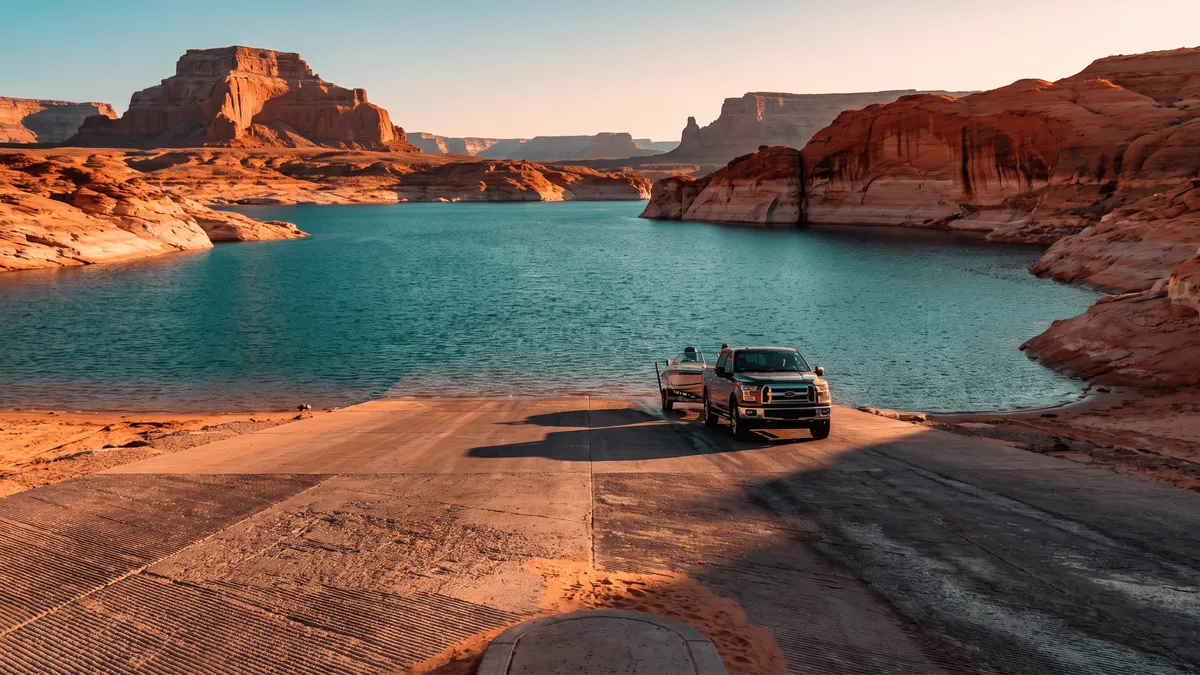
Two ramps, and they sit roughly 96 lake miles apart. The Park Service ramp status table dated 8/16/2026 lists Wahweap Stateline Auxiliary at the south end as available to houseboats and small motorized boats, with steel plate mats laid at the bottom of the ramp. Bullfrog North covers the north end, marked launch-at-your-own-risk and best suited to vessels under 25 feet. Everything else is closed to motors: the Wahweap and Bullfrog main ramps and the Antelope Point public ramp take paddlecraft only, Halls Crossing is closed to all vessels, and Hite sits out of the water entirely.
Ramp status changes with the lake, so check which ramps are open or closed at lakepowellwaterlevel.com before you hitch up. Expect company when you get there. The park’s February 2026 release told boaters to “anticipate increased congestion at Stateline Auxiliary Ramp” and to “plan additional time for launching and retrieval,” and a Reddit thread from February said the same thing in boater terms: on the south side, Stateline Auxiliary is the only ramp available. Rig the boat in the parking lot before you back down. Per-ramp detail by marina is in the marina guides.
What happens when you pull the boat out?
The exit is where the rules get teeth. Utah’s Lake Powell boating page tells boaters to remove all drain plugs and sea strainers while still on the launch ramp, keep them out during transit, pump every ballast tank dry, and drain water from the engine — lower the outdrive and let it run. Then stop at the inspection station, which applies to kayaks and paddleboards as much as to a 24-foot cuddy. Division of Wildlife Resources technicians work the ramps most daylight hours, and they check boats leaving the lake rather than arriving. After a clean inspection they put orange wire seals on the boat and trailer and hand you a receipt. Leave both alone: removing a seal before your dry time is up is illegal, and showing the receipt at your next lake gets you through that gate faster.
Weekends back up. The state warns that inspection and decontamination waits at Lake Powell can run over an hour, because technicians keep finding live mussels on anchors and in sea strainers. Pull in with the compartments already open — the Park Service asks boaters to make them accessible — and the stop takes 5 minutes instead of 20. Anglers get one extra chore: dump the livewell before you leave, since the same standing water carries the same larvae. The fishing guide covers the license side of that trip.
How long before your boat can launch somewhere else?
Utah sets the wait by season, and the numbers are on the state’s self-certification form: dry the boat 7 days from June through August, 18 days in spring and fall, and 30 days from December through February. Boats with inboard or I/O engines, ballast tanks or other raw-water systems sit out 30 days in every season, because water in those systems can’t be verified by looking. Professional decontamination is the way around the wait — certified crews wash the boat and trailer inside and out with 140°F water and flush the ballast, bilge, livewells and motor, and the boat’s clear that day.
Arizona runs a parallel clock. If the boat was on listed waters for 6 or more consecutive days, the state requires decontamination plus desiccation before you transport it or launch elsewhere: 18 consecutive days from November through April, 7 consecutive days from May through October. A 4-day weekend stays under that trigger; a week-long trip doesn’t.
One piece of paperwork closes the loop. Utah’s self-certification form gets signed and placed signature-side-up on the dashboard of the tow vehicle before you launch at the next lake, and the form itself carries the warning that providing false information is unlawful. Fill it out at home while you still remember which day you pulled the plugs.
Key takeaways
- A motorized boat needs a park entrance pass and a separate Glen Canyon vessel pass — $30 a week for boats 26 feet and under, $60 for the year.
- Home-state registration covers a visit: 90 days a year in Arizona, 60 in Utah. The Utah limit is the one that binds you.
- Only Wahweap Stateline Auxiliary and Bullfrog North take a trailered motorized boat, per the 8/16/2026 ramp table.
- Pull the plugs and sea strainers at the ramp and stop at every open inspection station on the way out — Utah rules require it.
- Before the next lake, sit out the seasonal dry time — 30 days flat if the boat has an inboard, I/O or ballast tanks — or pay for a 140°F decontamination and skip it.
Frequently asked questions
Do you need a permit to bring your own boat to Lake Powell?
Two Park Service payments cover it. The first is the park entrance fee — $30 per private vehicle for 7 days, or $55 for the annual Glen Canyon pass. The second is a Glen Canyon vessel pass, which the park says is required for operating a motorized vessel on Lake Powell or the Colorado River portion of Glen Canyon. It is priced by boat length and sold weekly or annually, and it’s separate from the entrance fee.
How much is the Glen Canyon vessel pass?
The Glen Canyon vessel pass is priced by boat length, weekly or annually. Personal watercraft and eFoils 16 feet and under pay $20 a week or $40 a year. Boats 26 feet and under, which covers most trailered runabouts, pay $30 a week or $60 a year. Bigger hulls climb through 5 more tiers to $800 a week or $1,600 a year for anything over 100 feet. The pass is separate from the park entrance fee.
Can you launch a boat registered in another state at Lake Powell?
Yes, for a visit. Arizona lets non-residents operate on state waterways with home-state registration for up to 90 days a year without re-registering. Utah exempts a properly registered out-of-state boat that has not been in Utah more than 60 days in a calendar year. The state line runs through the lake, so the 60-day figure is the one to count against. Boats kept at Lake Powell year-round need registration in Utah or Arizona.
Which Lake Powell ramps are open for trailered boats?
Two ramps take a trailered motorized boat, as of the Park Service ramp table dated 8/16/2026. Wahweap Stateline Auxiliary serves the south end and takes houseboats and small motorized boats. Bullfrog North serves the north end, listed as launch-at-your-own-risk and best suited to vessels under 25 feet. The main ramps at Wahweap and Bullfrog and the public ramp at Antelope Point are paddlecraft-only, Halls Crossing is closed to all vessels, and Hite no longer reaches the water. Check the table before you tow.
Is the boat inspection at Lake Powell mandatory?
Yes on the way out. Utah runs exit inspections at Lake Powell, and anyone with a boat, kayak, canoe or paddleboard has to stop at the stations when they are open. Technicians apply orange wire seals to the boat and trailer and hand over a receipt, and pulling that seal before your dry time is up is illegal. Before you climb the ramp, remove all drain plugs and sea strainers and leave them out, pump the ballast tanks dry, and drain the engine.
How long does a boat have to dry after Lake Powell?
Utah sets the dry time by season: 7 days from June through August, 18 days in March through May and September through November, and 30 days from December through February. Boats with inboard or I/O engines, ballast tanks or other raw-water systems carry a 30-day dry time year-round because the water in them cannot be verified. Professional decontamination with 140°F water is the alternative, and it clears the boat the same day.
Do you need the Utah mussel-aware boater course for Lake Powell?
Yes, and it covers paddlers too. Utah requires all boaters — motorized and non-motorized — to complete the annual mussel-aware boater education course and carry proof, printed or in the DWR Hunting and Fishing app. Boats with motors also enroll in the Utah AIS Program, pay the annual fee ($20 for Utah residents, $25 for non-residents) and stick a current-year AIS decal on the bow. Non-residents launching at Lake Powell follow the same rule.
Know the ramp before you tow
The Navigator map marks the launch ramps and all 4 marinas, and it keeps working offline once the signal quits a few miles up-lake.