
Lake Powell cell service: where you get bars, and where you don’t
Verizon carries most of Lake Powell from one tower on Navajo Mountain. Where the bars stop, what still works without them, and how to call for help.
Quick answer
Where boaters actually get a signal
Reports from the Wayne’s Words forum, where Lake Powell regulars compare carriers year after year, line up with the coverage aggregators. This is the picture as of mid-2026.
| Where you are | What boaters report | Plan on |
|---|---|---|
| Page, Arizona | All three carriers usable | Reliable service |
| Wahweap and Antelope Point | Verizon solid, AT&T workable | Service at the dock |
| Padre Bay (open water) | Verizon good, AT&T voice reported | Patchy, sightline-dependent |
| Main channel with Navajo Mountain in view | Verizon LTE, including Dungeon Canyon | Usable in stretches |
| Rock Creek Bay, near the floating restroom | Named as a local text-and-data spot | A known hotspot |
| Side canyons, back of the coves | Nothing on any carrier | No service |
| Rainbow Bridge and Forbidding Canyon | Mixed AT&T reports, nothing dependable | No service |
| Bullfrog and Halls Crossing | Verizon usable, some T-Mobile reported | Thin but present |
| Hite and the far north lake | Poor to none | No service |
Two things jump out of that list. The good spots cluster around open water rather than around the marinas, and the difference between four bars and zero is often a single bend in the canyon.
Which carrier works best on Lake Powell?
Verizon, and the gap is wide. Boaters running Verizon report voice, text and LTE data in places the other carriers give up, including Dungeon Canyon with a clear line to Navajo Mountain, and it is the carrier most likely to hold on across open stretches of the main channel. If you are choosing a phone to bring, bring the Verizon one.
AT&T sits second. It works around Page and at the south marinas, and one boater reported voice as far out as Padre Bay, while another called it worthless anywhere but the marinas. Both can be true on this lake, which is the point about sightlines.
T-Mobile is the weakest at the south end and has been for years. Farther north the reports improve: one boater listed decent coverage around Bullfrog, Halls Crossing, Moqui, Hansen Creek, Cedar, Iceberg and Annie’s, with the caveat that you turn a corner and the signal is gone. That caveat applies to all three carriers.
Why does coverage follow sightlines instead of distance?
Because most of the south lake’s service comes from one tower on Navajo Mountain, and cell signals at these frequencies do not bend around sandstone. If your boat can see the mountain, you have a decent chance of bars. Slide into a side canyon with 400 feet of Navajo sandstone between you and the antenna and the signal stops, even though you have moved a few hundred yards and are no farther from Page than you were.
That is why the map of usable coverage looks nothing like a set of circles around the marinas. Dungeon Canyon holds LTE at its mouth because the sightline is open. The back of the same canyon is dead. The floating restroom west of the entrance to Rock Creek Bay became a known calling spot because it happens to sit where the geometry works, not because anything was built there.
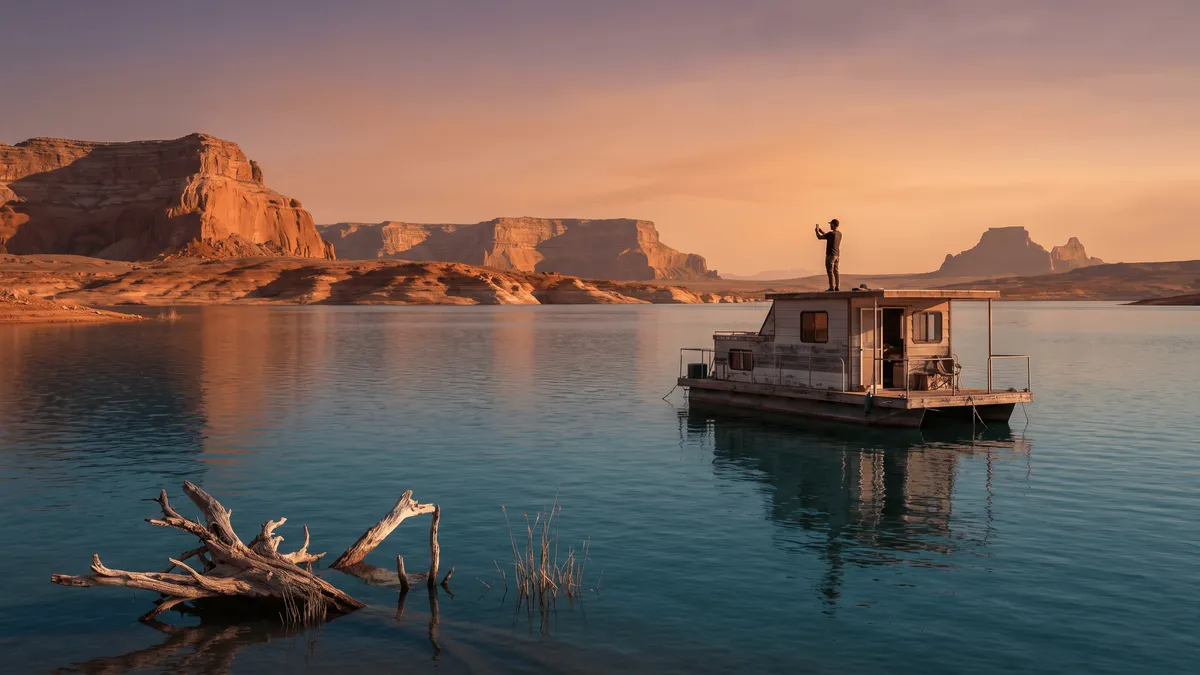
Practical version: if you need to make a call, get out of the canyon and into open water, and get high. Standing on the top deck of a houseboat in the middle of a bay is the best antenna position you have.
How do you call for help with no bars?
Carry a VHF radio. The National Park Service is direct about this on its Glen Canyon conditions page: “If you are having an emergency, call 911 or hail National Park Service on Marine Band 16.” In most of the park, the first half of that sentence is not available to you, which leaves Marine Band 16 as the channel that matters.
Marine Band 16 is the hailing and distress channel. Even when no ranger is in range to answer, other boats monitoring 16 can hear you and relay, and on a summer weekend there are a lot of boats. The NPS lists Marine Band 16 as the contact method for the Halls Crossing Boater Contact Station, which is staffed in summer.
VHF has the same weakness as cell, though: it is line-of-sight, and a distress call from the back of a side canyon may not reach anyone. That is the argument for carrying a satellite messenger as well on any trip that leaves the busy water.
The park’s main number, 928-608-6200, is a business line and the NPS notes it is not monitored when the building is closed. Do not save it as your emergency plan. The emergency procedures guide covers what to do once you have made contact.
Does satellite texting work out here?
Better than it does in most places, because Lake Powell gives you the one thing satellite messaging needs: open sky. Apple supports Emergency SOS via satellite and Messages via satellite on iPhone 14 and later, free for two years after the phone is activated, and its guidance is to be outside with a clear view of the sky. On open water that is easy. In a slot canyon with a 20-foot strip of sky overhead, it is not.
T-Mobile’s T-Satellite, running on Starlink satellites, costs $10 per month per line and is included at no extra cost on its Experience Beyond plan. It covers texts, picture messages, location sharing, a short list of satellite-optimized apps and text to 911, and T-Mobile says most smartphones from the last four years work with it. Data speeds are limited by design.
For anything you would call a real safety net, a dedicated device still wins. Garmin’s inReach plans run $17.99, $34.99 and $59.99 per month month-to-month, and the SOS button routes to a staffed emergency coordination center rather than to whoever happens to be monitoring a radio.
Can you get online at the marinas?
At Wahweap, yes. Lake Powell Resort lists free Wi-Fi in guest rooms, and its $14.99 nightly resort fee covers in-room Wi-Fi that used to be lobby-only. Antelope Point Marina does not publish a guest Wi-Fi policy, and the Bullfrog and Halls Crossing pages do not mention one either, so treat those as an ask-at-the-desk question. None of it follows you onto the water.
Two workarounds show up on the houseboats. A cell booster with a roof antenna helps where a weak signal already arrives — one owner reported good to very good service in spots that used to be dead, including the back of Dungeon Canyon — and does nothing in a true dead zone. Starlink Mini has become common on private houseboats, and boaters report it working at anchor, though rental boats from the marinas do not come with it.
What this means for your trip
Plan the trip as though the phone is a camera. Fuel stops are the sharpest example: with Dangling Rope Marina gone, the run to Rainbow Bridge is a round trip near 100 miles with no fuel in the middle, and you cannot look up a marina’s hours from buoy 40. Sort that out at the dock. The houseboat rental guide and the canyons guide both work through the range math.
Your GPS keeps working regardless, because position comes from satellites rather than from your carrier. The map is the part that needs caching, and the offline GPS guide covers the settings that keep your dot steady against canyon walls. Tell someone on shore your route and a check-in time before you leave, since a missed call from the lake means nothing on its own.
Key takeaways
- Most of Lake Powell has no cell service, and the south-end coverage that exists comes largely from one tower on Navajo Mountain.
- Verizon reaches farthest, AT&T works around Page and the south marinas, and T-Mobile is thinnest at the south end.
- Coverage follows sightlines, so open water and height matter more than how close you are to a marina.
- Carry a VHF radio and know Marine Band 16 — the NPS names it alongside 911 as the way to reach rangers.
- Satellite texting suits this lake because the sky is open, but narrow canyons still block it.
Frequently asked questions
Is there cell service on Lake Powell?
Mostly no. The south end near Page, Wahweap and Antelope Point has usable service, and stretches of open water with a clear sightline to the tower on Navajo Mountain hold a signal. Past that, coverage drops off fast, and the narrow side canyons that make up most of the shoreline have none at all. Treat a signal as a bonus rather than something to plan around, and do your downloading before you leave the marina.
Which cell carrier works best at Lake Powell?
Verizon, by a wide margin, according to boater reports and coverage aggregators as of mid-2026. AT&T is usable around Page and the south marinas, with voice reported as far out as Padre Bay, but it thins quickly once you leave the developed end. T-Mobile is the weakest at the south end, though boaters have reported workable service around Bullfrog, Halls Crossing and the nearby north-lake canyons. No carrier covers the whole lake.
How do you call for help on Lake Powell with no cell service?
The National Park Service tells boaters to call 911 or hail the National Park Service on Marine Band 16. With no bars, the VHF radio is what you have left: Marine Band 16 is the hailing and distress channel, and it can reach other boats within radio range even when no ranger hears you directly. VHF is line-of-sight too, so a call from deep in a side canyon may not get out. The park’s main number, 928-608-6200, is not monitored when the building is closed, so it is not an emergency line.
Does satellite texting work at Lake Powell?
Yes, and the open water suits it. Apple supports Emergency SOS and Messages via satellite on iPhone 14 and later, free for two years after activation, and it needs a clear view of the sky. T-Mobile sells T-Satellite for $10 per month per line, included on its Experience Beyond plan, covering texts, picture messages and text to 911. A Garmin inReach subscription starts at $17.99 per month month-to-month. Deep, narrow canyons still block the sky.
Do Lake Powell marinas have Wi-Fi?
Lake Powell Resort at Wahweap includes free Wi-Fi in guest rooms, covered by its $14.99 nightly resort fee. Antelope Point Marina does not publish a guest Wi-Fi policy on its site, and the Bullfrog and Halls Crossing pages do not either, so ask when you check in. Marina Wi-Fi covers the lodging and dock area only, which does nothing for you once you are on the water. Download what you need before you cast off.
Do cell boosters work on Lake Powell?
Sometimes. A booster amplifies a weak signal that already reaches your boat, so it can turn one unusable bar into a working call. It cannot create coverage where none exists, which is the situation in most side canyons. One houseboat owner on the Wayne’s Words forum reported good service in previously dead spots after installing a 4G/LTE booster with a roof antenna. Height and a clear line to the tower matter more than the amplifier itself.
Do I need cell service for my boat GPS to work?
No. Position comes from GPS satellites, which have nothing to do with your carrier, so the blue dot tracks with the SIM pulled and the phone in airplane mode. The part that needs a connection is the map picture — tiles, labels and search — which is why an uncached map shows a dot floating on grey. Cache the lake at the marina and the map travels with you.
The map shouldn’t depend on a tower
The Navigator app downloads all 61 mile-marker buoys and 132 named canyons to your phone, so your position, waypoints and route keep working in the coves where no carrier reaches.