
Lake Powell paddle boarding: 9 spots and how early to launch
Nine wind-protected places to paddleboard on Lake Powell, what boards rent for in Page, and the Park Service rule that lets you launch off any shoreline.
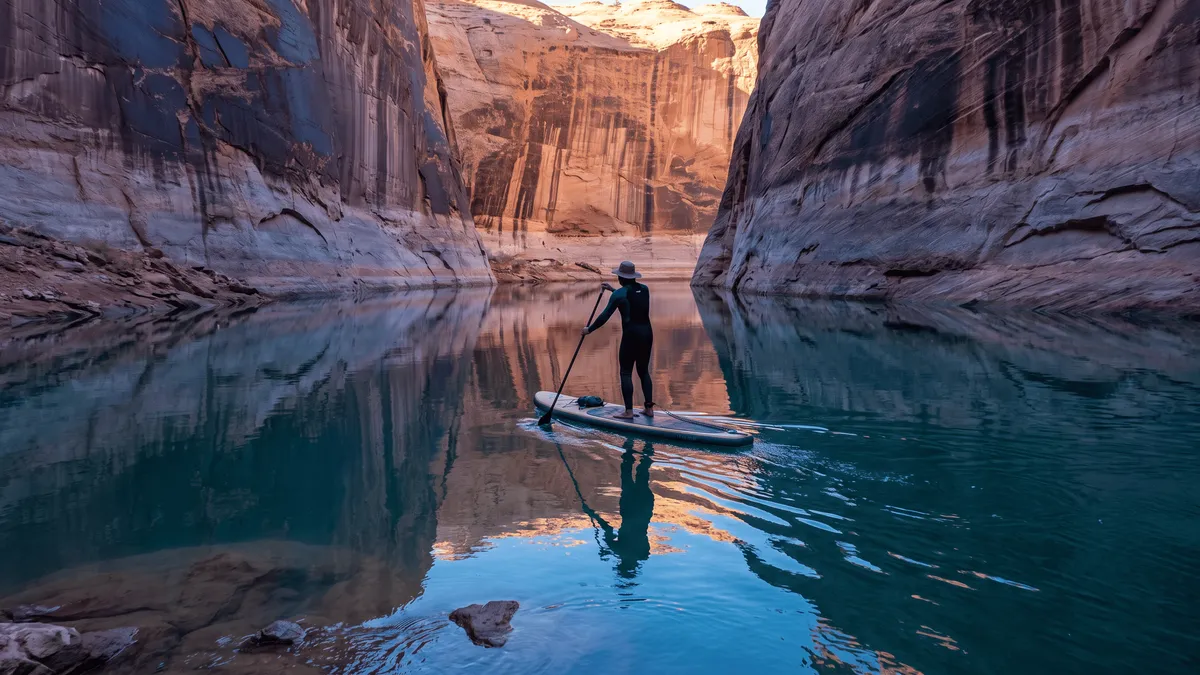
Quick answer
The best paddleboarding on Lake Powell is the Antelope Canyon arm out of Antelope Point — 2.5 miles of walled water where powerboats are held to 5 mph by rule. Launch by 7:30am. Wind builds through most afternoons and April is the windiest month here. The Park Service opens the entire shoreline to hand-launching, so no ramp is required and no permit or launch fee applies.
A board has a problem a kayak doesn’t: you stand up, so you are the sail. That single fact decides where you paddle on this lake and what time you start. Every spot below is ranked by shelter first and distance second.
| Spot | Where you put in | One-way distance | Wind exposure | Best for |
|---|---|---|---|---|
| Antelope Canyon arm | Antelope Point public ramp | 2.5 miles to the sand | Sheltered once inside | The paddle worth planning around |
| Wahweap Bay coves | Wahweap main ramp | 0.5 to 2 miles | Moderate | Your first outing on this lake |
| Lone Rock Beach | Off the sand, no ramp | 1 to 3 miles | Exposed | Driving to the waterline |
| The Chains | Slickrock carry-in east of the dam | Under a mile | Walled, but wake-prone | Deep water without a boat |
| Warm Creek Bay | Boat or a long paddle from Wahweap | 5+ miles | Sheltered coves | Paddling off a houseboat |
| Padre Bay coves | Boat-supported | Varies | Open water outside the coves | Calm mornings only |
| Labyrinth Canyon | Shuttle from Wahweap or Antelope Point | ~1 mile inside | Sheltered | Finishing a slot on foot |
| Bullfrog Bay | Bullfrog main ramp | 1 to 4 miles | Moderate | The north-lake base |
| Moqui and Lost Eden | Halls Crossing — ramp closed | 4.5 and 1 mile | Sheltered | Boat-supported only right now |
Antelope Canyon arm: the paddle worth planning around
This is the one people drive to Page for. The Antelope Point Public Launch Ramp sits at the end of Navajo Route 22B, and the Park Service page, updated 2026-02-24, lists it as “currently only available for non-motorized paddlecraft hand launching” — a closure for powerboats that hands the ramp to you. The mouth of the arm is about a mile out; it’s roughly 2.5 miles to where the water quits on a sand beach, and the walls close in for most of that.
The rule that makes it work is in the Superintendent’s Compendium: operating over 5 mph or creating a wake is prohibited in Antelope, Labyrinth, Forbidding and Lost Eden Canyons, and the stated reason is the “public safety issues of being in close proximity of small non-motorized watercraft.” Four canyons on this lake are legally slowed down for the sake of people on boards and in kayaks. Antelope is the one you can reach without hiring anything.
Paddlers who’ve done it are consistent about the details. Launch by 7:30am to get ahead of the tour traffic and the wind. Take the right side of the ramp — the left is sandy and steep. And expect chop even on a still morning, because the arm is narrow enough that boat wake, as one trip report put it, “just sloshes around basically forever.”
The slot canyon from the posters is a separate place on the other side of Page. Our slot canyon guide covers the split, along with the Navajo Nation fees and mandatory guides that apply to the road-accessed canyon.
Wahweap Bay: where to learn this lake
Wahweap is the gentle option, and 2026 made it gentler. As of the park’s 7/30/2026 ramp update, Wahweap Main is closed to motorized vessels and “open to paddlecraft only,” while the powerboat traffic runs through Stateline Auxiliary instead. You get a paved ramp, a short carry and no trailers backing down on top of you.
The coves off the bay run half a mile to 2 miles, which is the right scale for a first morning standing up on unfamiliar water. You’re close to Page, close to help, and the shoreline is broken enough that you can land almost anywhere if the wind turns. Both Page outfitters deliver here free at 8am.
Lone Rock Beach: park on the sand, put in anywhere
Lone Rock is the drive-on beach — you take the vehicle down to the waterline and launch off the sand. The Compendium allows vessels up to 25 feet to launch at the designated area May through October, and a board sits well inside that.
The trade is exposure. Lone Rock opens onto Wahweap Bay with real fetch behind it, so a breeze that’s a nuisance in a cove is a problem here. Morning only, and stay inside the shoreline curve rather than committing to a crossing. The soft sand also swallows two-wheel-drive vehicles with some regularity, so park on the packed track. Day use is covered by the entrance fee; camping runs $14 per vehicle per night, which our beaches guide gets into.
The Chains: a slickrock carry for deep water
The Chains is the Page local’s swim spot, and it works for a board if you’re willing to carry one down open rock. A gravel road east of Glen Canyon Dam, past the Hanging Gardens trailhead, ends at two parking lots with toilets and nothing else. From there you pick your own line down the slickrock to water that’s deep right off the stone edge.
An inflatable is the sane choice here — a hard board down a slickrock scramble is a two-person job. The channel is walled enough to block most wind, but you’re near the main line of boat traffic above the dam, so wake is the hazard rather than chop. The road is gated sunset to sunrise, and our swimming guide covers the access in more detail.
The five spots that need a boat behind them
Distance, not difficulty, is what puts the rest of this list out of reach. Labyrinth Canyon is the best paddle on the lake and a 32-mile round trip from Antelope Point, so the standard method is a water taxi — roughly $150 to $200 an hour for up to 6 people with boats, about an hour round trip to Labyrinth. Our kayaking guide has the full shuttle table.
Warm Creek Bay and the Padre Bay coves are houseboat water: you get there under power, then paddle the sheltered pockets in the morning. Padre is the lake’s largest open water, which is a warning as much as a description — beautiful at 7am, unmanageable by 3pm.
The north end got harder in 2026. As of the same 7/30/2026 update, the Halls Crossing launch ramp is “closed to all vessels,” which strands the two best short canyon paddles on the lake: Lost Eden about a mile downstream of the marina and Moqui about 4.5 to 5 miles upstream, both named by the Park Service kayaking page. Reaching either now means running down from Bullfrog. Bullfrog Main is paddlecraft-only, and Bullfrog North is open with a “launch at your own risk” notice.
Can you launch a paddleboard anywhere on Lake Powell?
Yes, and it’s written down. Under 36 CFR § 3.8(a)(2), the Compendium lists the six public ramps and then adds a line that changes the whole calculus for paddlers: “The entire shoreline of Lake Powell is open to the launching and retrieving of non-motorized vessels.” A ramp is a convenience for you, not a requirement.
That’s why the 2026 ramp situation reads differently from a board than from a powerboat. Three ramps — Wahweap Main, Antelope Point Public and Bullfrog Main — are closed to motorized vessels and open to paddlecraft. A paddleboard currently has more legal access to this lake than a ski boat does. Ramp status moves with the reservoir, and lakepowellwaterlevel.com tracks that side of it.
Costs stay simple. The Glen Canyon vessel pass is required for operating a motorized vessel, so a board owes nothing on top of the entrance fee: $30 per private vehicle, $25 per motorcycle, $15 per person on foot or bike, all good for 7 days, or $55 for the annual park pass. Utah registers a craft only when a motor or sail is attached, and Arizona takes the same position on paddlecraft.
When does the wind shut this lake down?
Around midday, most of the year. Page averages 8.9 mph of wind in April, the windiest month, and the windier season runs from late February into mid-July. Those monthly averages hide the part that matters — a representative Page day ran 4 mph at 9am and 20.6 mph by 6pm, with gusts to 36.4 mph.
That afternoon build is the whole safety problem for a board. British Canoeing’s offshore-wind guidance puts a number on it: in a Force 4 wind of 18 to 20 mph, a paddler can drift about a mile in 30 minutes. On Lake Powell that drift carries you into open channel with vertical sandstone on both sides and nowhere to land, which is why the local advice is so blunt — launch at first light, turn around at 11am, be off by noon.
Two seasonal wrinkles. July through September is monsoon season, when afternoon thunderstorms build fast and the gust front arrives before the rain. And the canyon walls that shelter you also funnel wind, so a canyon that’s glass at 8am can be a wind tunnel pointing the wrong way at 2pm. Our weather safety guide covers reading the sky here.
What you have to carry, and what a board costs
The Coast Guard has classified a stand-up paddleboard as a vessel outside a swimming or surfing area since 2008, which is what pulls the boating rules onto your board. In practice: one properly sized Coast Guard approved life jacket per person aboard, worn at all times by children 12 and younger, in both Utah and Arizona. Add a whistle for the sound-signal requirement and a white light if you’ll be out past sunset. Wear the leash. One stricter rule applies below Glen Canyon Dam, where the Compendium requires all occupants of hand-propelled craft to wear a PFD while underway.
Rentals sit in a narrow band as of mid-2026. Lake Powell Paddleboards starts at $60 a day for Wahweap Bay and $65 for the Antelope Canyon arm, including a board, paddle, life jacket, maps and free delivery to the Wahweap or Antelope Point launch ramps. Kayak Lake Powell runs inflatables at $60 a day for a single and $75 for a two-person board, dropping to $45 and $50 at 3 days or more, with the 7th day free on a 6-day rental. Hidden Canyon Kayak, worth naming because it comes up in searches, rents kayaks rather than boards. The marinas themselves don’t advertise SUP rentals — Antelope Point Marina rents kayaks by the hour.
Key takeaways
- The Antelope Canyon arm is the best board paddle on the lake: 2.5 miles each way from Antelope Point, inside a canyon where powerboats are legally held to 5 mph.
- You don’t need a ramp. The Compendium opens the entire shoreline to launching non-motorized vessels, and three of the lake’s ramps are paddlecraft-only in 2026 anyway.
- Launch by 7:30am and be off the water by noon. Wind builds through most afternoons, and 18 to 20 mph can push a paddler a mile in half an hour.
- No permit, no launch fee, no registration — just the park entrance fee, $30 per vehicle for 7 days.
- Budget $60 to $75 a day for a rental delivered free to Wahweap or Antelope Point, and carry a life jacket, a whistle and a leash.
Frequently asked questions
Where is the best place to paddle board at Lake Powell?
The Antelope Canyon arm out of the Antelope Point public ramp — 2.5 miles of walled water where the Park Service holds powerboats to 5 mph. Wahweap Bay is the easier first outing, with short coves and a paved ramp that is closed to motorized launching and open to paddlecraft as of mid-2026. Lone Rock Beach lets you drive to the sand and put in wherever you park, at the cost of more wind exposure.
Do you need a permit to paddle board at Lake Powell?
No permit and no launch fee. The Glen Canyon vessel pass applies to motorized vessels, so a paddleboard needs nothing beyond the park entrance fee — $30 per private vehicle or $15 per person on foot or bike, both good for 7 days, with an annual pass at $55 as of mid-2026. Utah does not register a craft unless a motor or sail is attached, and Arizona treats paddlecraft the same way.
How much does it cost to rent a paddleboard at Lake Powell?
Roughly $60 to $75 a day from the Page outfitters as of mid-2026. Lake Powell Paddleboards starts at $60 a day for Wahweap Bay and $65 for the Antelope Canyon arm. Kayak Lake Powell runs $60 a day for a single and $75 for a two-person board, dropping to $45 and $50 at 3 days or more. Both include a paddle, a life jacket and free delivery to the launch ramp. Park entry is separate.
Is Lake Powell too windy for paddle boarding?
In the afternoon, often. Page averages 8.9 mph of wind in April, the windiest month, and the windier stretch runs from late February into mid-July. The daily pattern matters more than the monthly one: mornings are calm and wind builds through the afternoon, with gusts recorded above 35 mph. Paddlers who know the lake launch around 7:30am and are off the water by noon.
Can you paddle board to Antelope Canyon?
You can paddle the flooded Antelope Canyon arm, about 2.5 miles each way from the Antelope Point public launch to where the water ends on sand. The Antelope Canyon from the photographs is a different place, reached by road: Upper and Lower Antelope are units of the Lake Powell Navajo Tribal Park, where Navajo Nation Parks and Recreation charges $15 per person and guides are mandatory.
Do you have to wear a life jacket on a paddleboard at Lake Powell?
Children 12 and younger must wear one, and adults must carry a properly sized Coast Guard approved life jacket aboard. The rule is the same in Utah and Arizona. The Coast Guard has treated a stand-up paddleboard as a vessel outside a swimming area since 2008, which also brings in a sound-producing device — a whistle satisfies it — and a white light if you are out after dark.
Where can you launch a paddleboard at Lake Powell?
Anywhere you can reach the water. The Superintendent’s Compendium states that the entire shoreline of Lake Powell is open to the launching and retrieving of non-motorized vessels, so a board is not tied to a ramp. That matters in 2026, because Wahweap Main, Antelope Point Public and Bullfrog Main are closed to motorized vessels and open to paddlecraft only.
Mark your put-in before you push off
The Navigator app records your track and holds waypoints offline, so a shoreline launch with no ramp and no cell signal is still a point you can steer back to.