
Lone Rock Beach: camping, fees and driving onto the sand
Lone Rock Beach is where you drive onto the sand at Lake Powell and camp beside the truck. Fees, facilities, the soft sand, and the 25-foot boat launch limit.
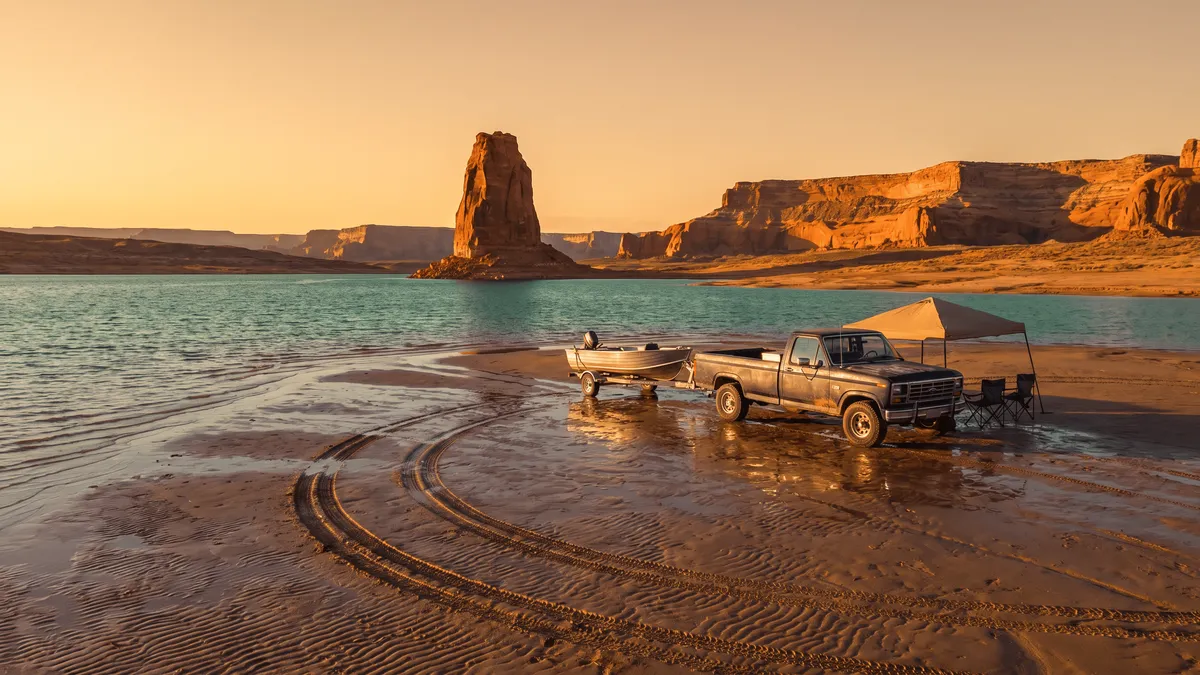
Quick answer
At Lone Rock Beach you can drive onto the sand, sleep next to your vehicle and beach a boat in the same spot. Camping is $14 per vehicle per night, first come, no reservations, on top of the $30 weekly entrance fee. Vault toilets run year-round; showers, water and the RV dump are seasonal. The sand gets soft near the water, and the park doesn’t guarantee a tow.
It sits off US-89 near the Utah line, a wide sand flat under the sandstone monolith it’s named for. What people love about it and what they complain about come from the same fact: you can drive a loaded truck to the waterline. That means big groups, trailers, coolers and shade structures beyond what a boat-in camper can carry. It also means ATVs on the sand and generators at the next site over.
| What | Detail |
|---|---|
| Camping fee | $14 per vehicle, per night ($7 with a Senior or Access pass) |
| Entrance fee | $30 per private vehicle for 7 days, charged separately |
| Reservations | None — first come, first served |
| Stay limit | 14 consecutive days; 30 days a year at fee campsites |
| Toilets | Vault toilets across the beach, open year-round |
| Showers, water, RV dump | On the paved section, seasonal |
| Potable water | The NPS page contradicts itself — carry your own |
| Boat launching | Beach launch, 25 ft and under; no motorized launching Nov–Apr |
| ORVs | The one place the park opens to non-street-legal vehicles |
| Towing | Not guaranteed if you bury a vehicle |
| Campfires | In NPS rings, or on the shoreline below 3,700 feet |
| Cell service | Patchy at the entrance, unreliable on the sand |
Where is Lone Rock Beach and how do you get there?
Lone Rock Beach is in Glen Canyon National Recreation Area on the Utah side of the state line, off US-89 between Page, Arizona and Big Water, Utah. The Park Service gives the directions in one line: “By vehicle, you can drive just near the state line on Hwy 89 to the turnoff, then to the entrance station.” Big Water sits about 12 miles north of Glen Canyon Dam on the same highway, so a run up from Page is a short one — about half an hour with a trailer.
The turnoff is signed and paved. You pass the entrance station, pay, and the paved road runs past the restroom and shower block. Past that the road turns to sand and drops toward the water. Glen Canyon is a cashless park, so buy the pass online or at a staffed station before you arrive — the automated fee machine at the booth takes cards for camping and vessel passes.
Where the water actually sits on that sand flat moves from season to season, which changes how far you drive and where the vehicle-free zone gets marked. For the current elevation and the trend behind it, lakepowellwaterlevel.com tracks it day to day.
What does it cost to camp at Lone Rock Beach?
Camping is $14 per vehicle, per night, and the Park Service is explicit that the “cost of park admission is not included in the camping fee.” Entrance runs $30 per private vehicle for 7 days, $25 for a motorcycle pass that admits up to 2 motorcycles and 4 people, or $15 per person arriving on foot or by bike, with anyone 15 and younger admitted free. A Senior or Access pass covers entrance outright and takes 50% off the camping fee, so $7 a night. If you’re launching a motorized boat, the vessel fee stacks on top and scales with hull length: $20 a week for personal watercraft and eFoils 16 feet and under, $30 for anything up to 26 feet, climbing to $800 a week above 100 feet.
For a family arriving Friday and leaving Sunday with one truck and a 21-foot boat, that’s $28 of camping, $30 of entrance and $30 of vessel fee, or $88 for the weekend. Sites aren’t numbered or assigned. You pay at the booth, drive in and pick your spot.
Stay limits run 14 consecutive days in one place, and 30 days a year across the park’s fee campsites, which is the bucket Lone Rock falls in. The 2026 compendium sets a separate 60-day annual total for dispersed, lake-based camping off a boat. For comparison, our Lake Powell camping guide has the nightly rates at the developed campgrounds at Bullfrog and Halls Crossing.
Can you drive onto the beach at Lone Rock?
Yes, and it’s the whole draw. It’s also the most common way a trip here goes wrong. The Park Service warning is short: “after the pavement ends, the roads get increasingly sandy the closer you get to the water,” followed by “no guaranteed towing service if you get stuck in the sand.” No rule requires 4WD, which is how sedans and rental minivans end up down a slope they can’t climb back out of.
Read the sand before you commit. The upper flat near the pavement stays firm enough for most vehicles. The closer you get to the waterline, the softer it runs, and it’s worst where the shoreline has recently dropped back. Pick firm, slightly raised ground, keep momentum, and don’t stop partway down a soft stretch to look at the view.
If you want to camp at the water with a heavy rig, bring the recovery kit you’d take to a dune: a shovel, traction boards, a tire gauge and a compressor. Airing down spreads the load better than horsepower does; air back up before you hit pavement. Arrive with a second vehicle when you can. Visitors on Tripadvisor describe the same two problems over and over — buried trucks and blowing sand — and the second one is the reason to stake everything down before dark.
Can you launch a boat at Lone Rock Beach?
You launch off the sand here, at what the Superintendent’s Compendium calls an undeveloped launch area, and it puts a ceiling on hull length: Lone Rock Beach “has an angle of underwater slope that precludes the launching of vessels exceeding 25’ in length.” Over 25 feet, you’re launching at a developed ramp downlake instead — the Wahweap Marina guide covers the options down there.
The second limit is seasonal: the compendium closes Lone Rock to launching all motorized watercraft from November through April. Paddle craft aren’t named in it, so a winter trip with kayaks still works, and the vault toilets stay open through it.
The payoff comes after launch. The Park Service notes you “may also keep your boat in the water next to your campsite,” so you skip the morning drive to a ramp queue for the rest of the trip. For a group towing their own boat, that’s the argument for Lone Rock over a developed campground; our guide on bringing your own boat to Lake Powell covers the inspection and registration side before you get here.
What are the rules at Lone Rock Beach?
Six rules cover most of what rangers enforce here.
- No saving beach space. The compendium prohibits reserving or roping off an unoccupied area at Lone Rock “to prevent the unreasonable restriction of camping beach space.” Your friends arriving Saturday find their own sand.
- There is a vehicle-free zone. The park designates a vehicle-free camping area each year “to accommodate visitors who wish to be separated from motor-vehicle users.” Its size and location shift with conditions, so read the posted map at the entrance rather than last year’s memory.
- Carry a toilet if you camp away from one. Anyone camping within ¼ mile of the shoreline needs a way to contain solid human waste — a portable toilet, an engineered bag system, or a self-contained toilet in an RV or boat — unless an open constructed toilet sits within 200 yards. The vault toilets across the beach cover a lot of the flat, not all of it. If you’re unsure how far back your site sits, carry one anyway.
- ORVs stay in their area, flagged. The Park Service calls Lone Rock “the only location within Glen Canyon National Recreation Area where non-street legal licensed vehicles are allowed to operate,” and the ORV ground is fenced by a post-and-cable barrier south of the main access road. Riders at the play area fly a solid red or orange flag at least 6 by 12 inches, mounted at least 8 feet above the ground on a vehicle, or on motorcycle headgear at least 18 inches above the operator’s head. Shoreline access areas are 15 mph unless marked, and Utah requires an OHV education certificate for operators under 18, with an adult within 300 feet for riders under 16.
- Fires go in a ring or below the old high-water line. Campfires are allowed in NPS-provided rings and grills, and along the shoreline below 3,700 feet, outside developed areas.
- Swim at your own risk. There are no lifeguards anywhere on this lake. The park’s standing advice on cyanobacteria applies at Lone Rock as much as anywhere: stay out if you see pale-green or pea-green scum, and keep dogs out of it too. The dog rules post has the rinse-and-don’t-drink detail.
Is Lone Rock Beach a good place to camp?
The answer splits by what you’re hauling. For a group with a boat and a week of food, the logistics are hard to beat — you park your entire trip 30 feet from the water and don’t repack it until you leave. Tripadvisor reviewers land on the same two things they liked: the setting and the sunsets.
For quiet, look elsewhere. Generators, ATVs and holiday-weekend crowds are the standard complaints, and the park runs Lone Rock as a primitive campground. One reviewer describes 2 a.m. wind hard enough to warrant earplugs and eye protection in a tent; that’s the detail first-timers underestimate. If you want sand without the engines, take a boat to Warm Creek Bay or Padre Bay — our beaches guide ranks 9 of them.
Cell service is unreliable between the entrance station and the waterline. Download the offline map and pull the wind forecast while you’re still in town, because anything that needs live data may not load once you’re parked on the sand. RV travelers should read the RV parks guide for where the dump stations are before committing to a week out here.
Key takeaways
- Lone Rock costs $14 per vehicle per night, first come; park entrance is a separate $30 for 7 days, and a Senior or Access pass halves the camping fee to $7.
- Sand softens as you drop toward the waterline and the park doesn’t guarantee a tow; bring 4WD, a shovel and traction boards if you camp down there.
- Beach launching is capped at vessels 25 feet and under, and closed to motorized watercraft November through April.
- The NPS Lone Rock page lists running water and a dump station in season, then says there is none of either. Fill up in Page before you turn off the highway.
- Noise comes with the drive-on access. ATVs and generators run late, and the 2 a.m. wind is what Tripadvisor reviewers warn tent campers about.
Frequently asked questions
How much does it cost to camp at Lone Rock Beach?
Camping at Lone Rock Beach is $14 per vehicle, per night. That’s a camping fee only — the National Park Service says the “cost of park admission is not included in the camping fee,” so add the Glen Canyon entrance fee: $30 per private vehicle for 7 days, $25 for a motorcycle pass, or $15 per person on foot or bike, with anyone 15 and younger free. A Senior or Access pass covers entrance and halves the camping fee to $7 a night. Launching a motorized boat adds a vessel fee scaled to length, from $20 a week.
Do you need a reservation to camp at Lone Rock Beach?
No. The National Park Service says of Lone Rock: “No reservations: Sites are first come, first served.” There is no site number and no assigned spot — you pay at the entrance station or the automated fee machine, drive through, and pick a patch of sand. Glen Canyon is cashless, so bring a card. Saving or roping off an unoccupied stretch of beach for friends arriving later is prohibited under the Superintendent’s Compendium, which exists to stop exactly that.
Do you need 4WD at Lone Rock Beach?
Not to reach the paved entrance area at Lone Rock Beach, but bring 4WD if you plan to camp near the water. The National Park Service warns that “after the pavement ends, the roads get increasingly sandy the closer you get to the water,” and follows it with the line that matters: “no guaranteed towing service if you get stuck in the sand.” Two-wheel drive handles the firmer upper flat. Below that, a high-clearance 4WD, aired-down tires, a shovel and traction boards are the difference between a weekend and a recovery bill.
Can you launch a boat at Lone Rock Beach?
Motorized boats under 25 feet, May through October. Lone Rock is an undeveloped sand launch, and the Glen Canyon Superintendent’s Compendium caps it by hull length: Lone Rock Beach “has an angle of underwater slope that precludes the launching of vessels exceeding 25’ in length.” The same compendium closes it to launching all motorized watercraft from November through April. Once you are on the water you can keep the boat beached next to your campsite, which is the reason many groups put up with the sand.
Are there bathrooms and showers at Lone Rock Beach?
Yes. Lone Rock Beach has toilets at two levels of comfort: vault toilets sit across the sand and stay open year-round, and the paved section near the entrance has flush and micro-flush toilets plus an outdoor shower station that runs in the warm season. The park’s April 14, 2026 season release listed those, potable water and RV dump services as open. The same Lone Rock page that lists running water and a dump station in season also states there is none of either, so fill your tanks in Page.
Can you ride ATVs at Lone Rock Beach?
The Park Service calls Lone Rock “the only location within Glen Canyon National Recreation Area where non-street legal licensed vehicles are allowed to operate.” The ORV area is fenced off by a post-and-cable barrier south of the main access road. Riders at the play area must fly a solid red or orange flag of at least 6 by 12 inches, mounted 8 feet above the ground on a vehicle or 18 inches above the operator’s head on motorcycle headgear. Shoreline access areas are 15 mph unless posted otherwise.
The wind at Lone Rock shows up at 2 a.m.
Marina-level wind and weather before you pitch a tent, plus the full offline map for the stretch of US-89 and shoreline where your phone drops to no bars.