
The Toilet Bowl at Lake Powell: what collapsed and what is left
The Toilet Bowl arch in Rock Creek Bay collapsed on August 8, 2024, with 20 to 30 people swimming inside it. The Park Service reported no injuries.
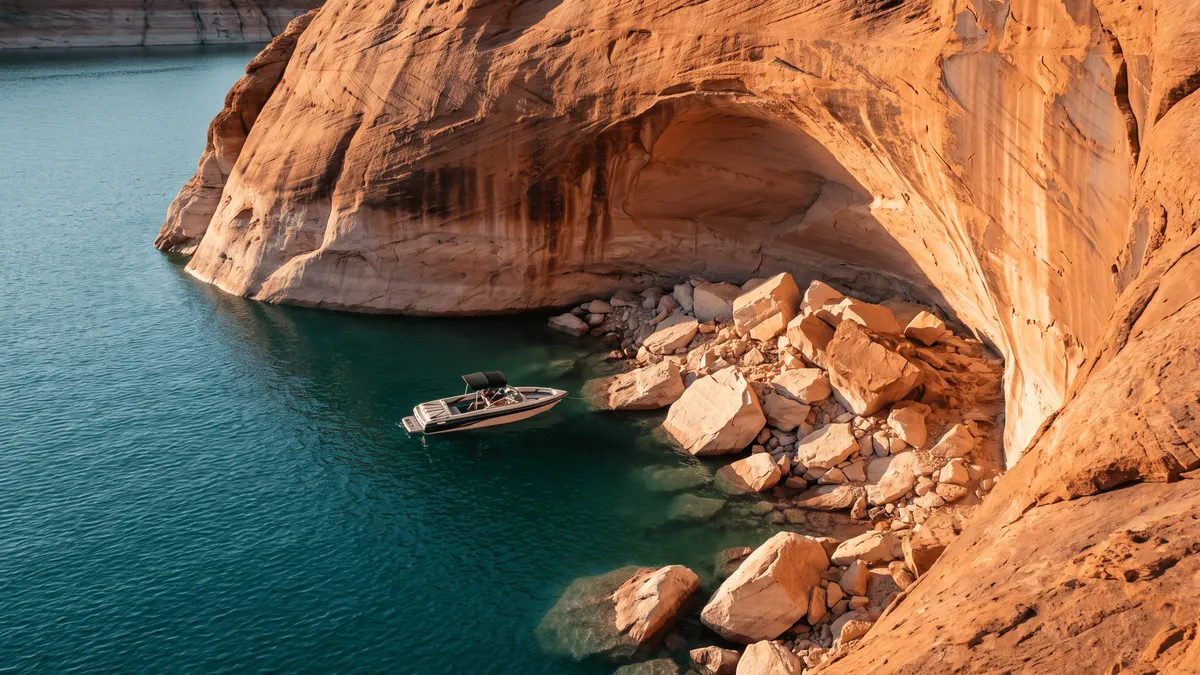
Quick answer
The Toilet Bowl was a sandstone arch over a pool in Rock Creek Bay, mid-lake on the Utah side around buoys 35 and 36. It came down on August 8, 2024: the first rock fell about 1 p.m. with 20 to 30 people inside the bowl, and about 5 hours later the arch was gone. The Park Service reported no injuries. Its official name was Double Arch, and boaters also called it Crescent Pool and Hole in the Roof. There is no arch left to boat to.
| Fact | Detail |
|---|---|
| Park Service name | Double Arch |
| Names boaters used | Toilet Bowl, Crescent Pool, Hole in the Roof |
| Where | Rock Creek Bay, Utah side, around buoys 35 and 36 |
| Collapsed | August 8, 2024, first rockfall about 1 p.m. |
| People in the bowl | 20 to 30 |
| Injuries | None reported |
| Suspected cause | Changing water levels and wave erosion (NPS) |
| The rock | Navajo sandstone, about 190 million years old |
| Status as of August 2026 | Gone |
Where was the Toilet Bowl at Lake Powell?
Rock Creek Bay, on the Utah side, up-lake around buoys 35 and 36 — published guides differ by a mile on which buoy marks the mouth. Buoy numbers count lake miles from Glen Canyon Dam, so that puts the bay mid-lake: past Padre Bay, short of buoy 49, where the Park Service puts the turn into Forbidding Canyon for Rainbow Bridge, with Dungeon Canyon the next landmark up-lake at buoy 38. The bay splits into three branches: Rock Creek, Middle Rock Creek and Dry Rock Creek.
A lot of search results file the Toilet Bowl next to Antelope Canyon, 30-odd miles down-lake. The Park Service release names Rock Creek Bay.
Castle Rock Cut, the shortcut out of Wahweap Bay, reads Closed to houseboats, small motorized boats and non-motorized craft alike on the Park Service access table last updated August 26, 2026. Cell coverage thins out fast in that stretch too — the floating restroom west of the mouth of Rock Creek Bay is a known calling spot, which our cell service map covers in detail.
What happened on August 8, 2024?
The arch came apart in stages, in the middle of a busy swimming afternoon. Merril Campbell of Hurricane, Utah, got there with friends and family at about 1 p.m. that Thursday and told KSL there were “twenty or thirty people that had kind of just jumped off and were hanging out inside the bowl.” Then he “heard a splash that sounded larger than someone jumping into the lake.” A couple of the men he was with saw “a big piece of rock fall off the bottom of the arch into the lake” — a rock he sized up as “like a Volkswagen.”
A swimmer on video yells, “Dude, we were under there! We barely left in time!” Campbell’s group came back about 5 hours later to see whether more rock had fallen. “There just wasn’t an arch left, and it was like smooth walls,” Campbell said. Where a 20 or 30-foot arch hole had been, he estimated a gap roughly 100 feet wide.
The Park Service posted its release the next day, recording no one hurt and pointing at erosion: the 190-million-year-old Navajo sandstone had been spalling from weather, wind and rain for a long time, and “changing water levels and erosion from wave action is suspected of contributing to the ultimate collapse.” For where the lake surface sits now and how it has moved, lakepowellwaterlevel.com tracks it daily.
Michelle Kerns, the park’s superintendent at the time, closed the release: “Please enjoy our resources but leave no trace.”
Is anything left at the site?
The arch is gone. The Park Service has not published a follow-up survey of the cove, and the accounts circulating since 2024 argue mostly about naming and about which video shows which formation.
That leaves two practical problems for a 2026 trip. Waypoints and coordinates for the Toilet Bowl are still circulating in trip reports and travel listicles written before the collapse. And some posts treat Hole in the Roof as a separate feature that survived, while the Park Service release puts all four names on the same arch.
The bay itself is still worth the run. Trip reports rate it as a mid-lake base because several side canyons and sandy camps sit close together there, and undeveloped shoreline camping carries no camping fee and no permit beyond what you paid at the gate. You do have to carry a portable toilet unless your vessel has one aboard or a toilet sits within 200 yards. Our camping guide covers the rules and the beaches.
Was jumping at the Toilet Bowl even legal?
The rule starts at 15 feet. The Park Service states on its swimming page that “Cliff Jumping/Cliff Diving is illegal. It is prohibited for any person to jump or dive off of rock cliffs, ledges, or man-made structures (excluding vessels).” The rule covers anything 15 feet or higher above the water.
Its safety page goes further. The agency does not advocate cliff jumping at any height, it says “there have been multiple deaths in Lake Powell due to cliff jumping,” and it does the arithmetic: “Realize if you leap from 50 feet up, you could be going almost 40 miles per hour when you hit the water.” Children 12 and younger must wear a Type I, II or III Coast Guard-approved life jacket when the boat is underway. The same page says there are no lifeguards and no designated swim beaches, and to swim at your own risk.
Rockfall is the hazard the rules say nothing about. Sandstone over water spalls without warning, and the people inside the bowl that afternoon got a few seconds of notice. Our cliff jumping guide walks through what the law allows and what the water under these spots is like.
Where do people swim now?
These three sit within a day run, and none of them needs a permit:
- Labyrinth Canyon. Beach on the sand in Labyrinth Bay, then swim, paddle or kayak up the flooded slot — one party got about 45 minutes up before the water ran out into sand. Motors are held to wakeless speed inside, so a small boat gets farther in. See the Labyrinth Canyon guide.
- Anasazi Canyon, between buoys 52 and 53. A short hike from the beach leads to a double arch with a waterfall and plunge pool. Details are in our slot canyons guide.
- Rock Creek Bay itself. It has sheltered coves, sand and 3 branches to pick from, on the run you were already making.
For beaches you can pull a boat onto and swim off, the beaches guide and the swimming guide cover the shoreline south of here.
What the trip costs
Glen Canyon charges twice: once to get in, once to float a motor.
| Fee | Price |
|---|---|
| Entrance, private vehicle, 7 days | $30 |
| Entrance, motorcycle | $25 |
| Entrance, per person on foot or bike | $15 |
| Glen Canyon annual pass | $55 |
| Vessel, PWC or eFoil 16 ft and under | $20 weekly / $40 annual |
| Vessel, 26 ft and under | $30 weekly / $60 annual |
| Vessel, 27 to 40 ft | $50 weekly / $100 annual |
| Vessel, 41 to 60 ft | $100 weekly / $200 annual |
Rates are from the Glen Canyon fees page, last updated May 27, 2026. Kayaks and paddleboards owe the entrance fee only. Fuel sets the ceiling on a run up to Rock Creek Bay and back, and our fuel planning guide does that math.
Key takeaways
- The Toilet Bowl collapsed on August 8, 2024. Double Arch is the Park Service name for it, and Crescent Pool and Hole in the Roof name the same rock.
- It stood in Rock Creek Bay around buoys 35 and 36, mid-lake on the Utah side, about 30 miles up-lake from Antelope Canyon.
- 20 to 30 people were inside the bowl when the first rock fell. No one was hurt.
- Jumping from anything 15 feet or higher above the water is illegal park-wide, and Glen Canyon has no lifeguards.
- Rock Creek Bay still works as a base camp, and Labyrinth and Anasazi canyons are the swim stops boaters point at now.
Frequently asked questions
Is the Toilet Bowl at Lake Powell still there?
No. The arch collapsed on August 8, 2024, and the Park Service confirmed it the next day. Its official name was Double Arch, and the release lists Toilet Bowl, Crescent Pool and Hole in the Roof as the other names boaters used for the same formation. Photos and GPS coordinates still circulating online show it intact, so a waypoint copied from an old trip report will put you in the right cove in Rock Creek Bay with nothing to swim through when you get there.
Where was the Toilet Bowl at Lake Powell?
Rock Creek Bay, on the Utah side of Lake Powell, up-lake around buoys 35 and 36. Lake Powell buoy numbers count lake miles from Glen Canyon Dam, which puts the bay mid-lake, past Padre Bay and short of buoy 49, the turn into Forbidding Canyon for Rainbow Bridge. Dungeon Canyon is the next landmark up-lake at buoy 38. Search results often file the Toilet Bowl next to Antelope Canyon, 30-odd miles down-lake from there; the Park Service release places it in Rock Creek Bay.
What caused the Toilet Bowl arch to collapse?
Erosion, though the Park Service stops short of naming one cause. Its release says the 190-million-year-old Navajo sandstone had been spalling and wearing from weather, wind and rain, and that “erosion from wave action” is suspected of contributing to the collapse. Michelle Kerns, the park’s superintendent at the time, called it “a reminder of our responsibility and need to protect the mineral resources surrounding Lake Powell.” Thin sandstone over open water spalls until it can no longer carry its own weight.
Was anyone hurt when the Toilet Bowl collapsed?
The Park Service reported no injuries. Boater Merril Campbell told KSL that 20 to 30 people had been jumping in and hanging out inside the bowl before the first piece let go around 1 p.m., and that a rock he described as Volkswagen-sized dropped out of the bottom of the arch into the lake. One swimmer is heard on video saying “Dude, we were under there! We barely left in time!” The full collapse left a gap Campbell estimated at about 100 feet wide.
Is cliff jumping legal at Lake Powell?
Not above 15 feet. The Park Service prohibits jumping or diving off “rock cliffs, ledges, or man-made structures (excluding vessels)” that stand 15 feet or higher above the water, and says it does not advocate cliff jumping at any height. It also warns that “there have been multiple deaths in Lake Powell due to cliff jumping,” and that a leap from 50 feet up can put you in the water at almost 40 miles per hour. Glen Canyon has no lifeguards and no designated swim beaches.
Where can you swim at Lake Powell instead?
Rock Creek Bay still works as a base, with several side canyons and sandy camps close together and no camping fee beyond the park entrance and vessel fees. Labyrinth Canyon has sand to beach on at its mouth and a flooded slot you swim or paddle up from there. Anasazi Canyon, between buoys 52 and 53, has its own double arch with a waterfall and plunge pool at the end of a short hike from the beach. A day visit to any of the three needs no permit.
How much does it cost to boat to Rock Creek Bay?
Two fees, both paid to Glen Canyon National Recreation Area. Entrance is $30 per private vehicle for 7 days, $25 by motorcycle, $15 per person on foot or bike, or $55 for the Glen Canyon annual pass. The vessel fee is separate for motorized boats: $20 weekly for a personal watercraft or eFoil 16 feet and under, $30 for boats 26 feet and under, $50 for 27 to 40 feet and $100 for 41 to 60 feet, with the annual rate at double the weekly in every band. Fuel is on you, and kayaks and paddleboards skip the vessel fee.
Know what is still standing before you point the boat
The Navigator app carries 18 arches and natural bridges on an offline map of Lake Powell, alongside all 61 mile-marker buoys and 132 named side canyons, so a run up to Rock Creek Bay is planned before you lose signal.